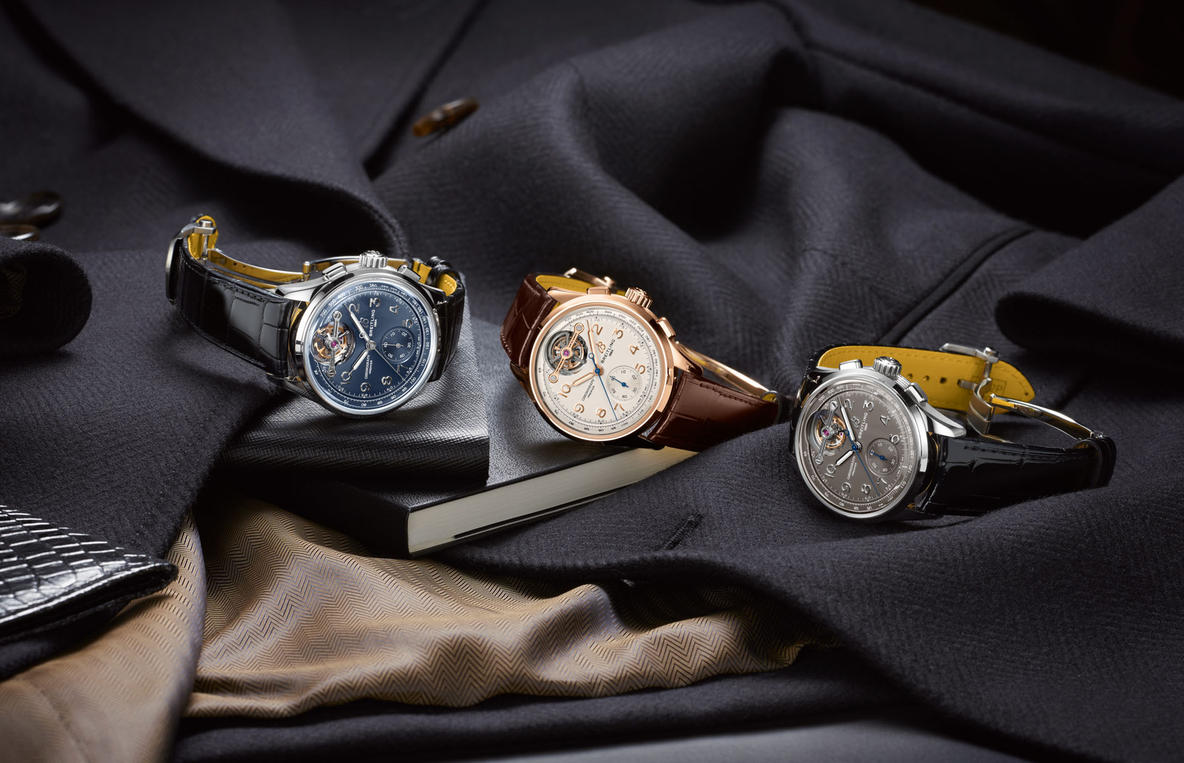
Several years after its introduction, the Breitling Premier B21 Chronograph Tourbillon 42 is easier to judge on its own merits. In 2026, Léon, Gaston and Willy no longer need the novelty of being new releases. What matters now is whether the idea still works: taking one of Breitling’s most restrained chronograph designs and giving it a tourbillon without turning the Premier into something visually unrelated to the rest of the collection.
It does. The Premier has always relied on proportion more than aggression. There is no Navitimer slide rule, no Superocean dive bezel and none of the heavier sports-watch detailing found on the Chronomat. Instead, the design is built around traditional Arabic numerals, rectangular chronograph pushers, relatively clean dial surfaces and a case that feels more formal than most modern Breitlings. That makes the Breitling Premier B21 Chronograph Tourbillon 42 a surprisingly logical place for the brand to explore a more complicated movement.
For YouReplica, a UK site focused on Breitling watches and replica models, the B21 is particularly useful because it shows how little room a Premier gives an inaccurate reproduction to hide. A replica can copy the general idea of a tourbillon at 12 o’clock and a chronograph register at 6, but getting the watch to feel like a Premier depends on much smaller details.
The B21 Works Because Breitling Kept the Premier Intact
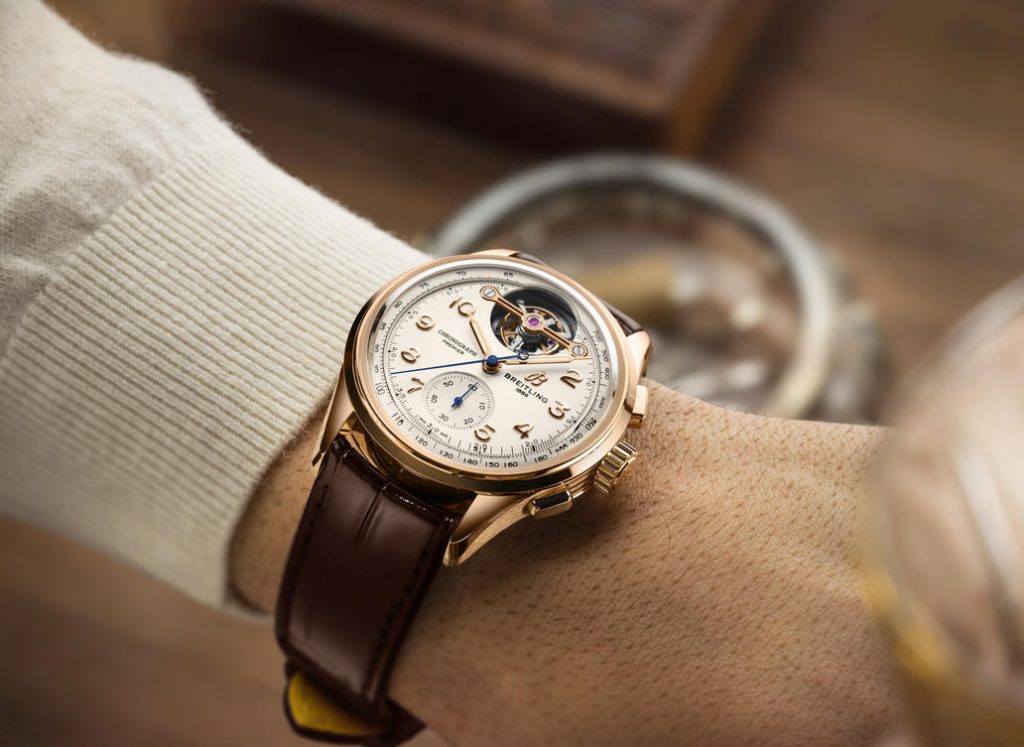
The three versions share the same 42mm case architecture but use very different precious metals. Léon comes in 18k red gold, Gaston in 18k white gold and Willy in platinum. The mechanical foundation is the same, yet the watches do not feel interchangeable. The red-gold Léon is warmer and more traditional, the white-gold Gaston is deliberately understated, and the platinum Willy has the coolest and most contemporary character, especially with its blue dial.
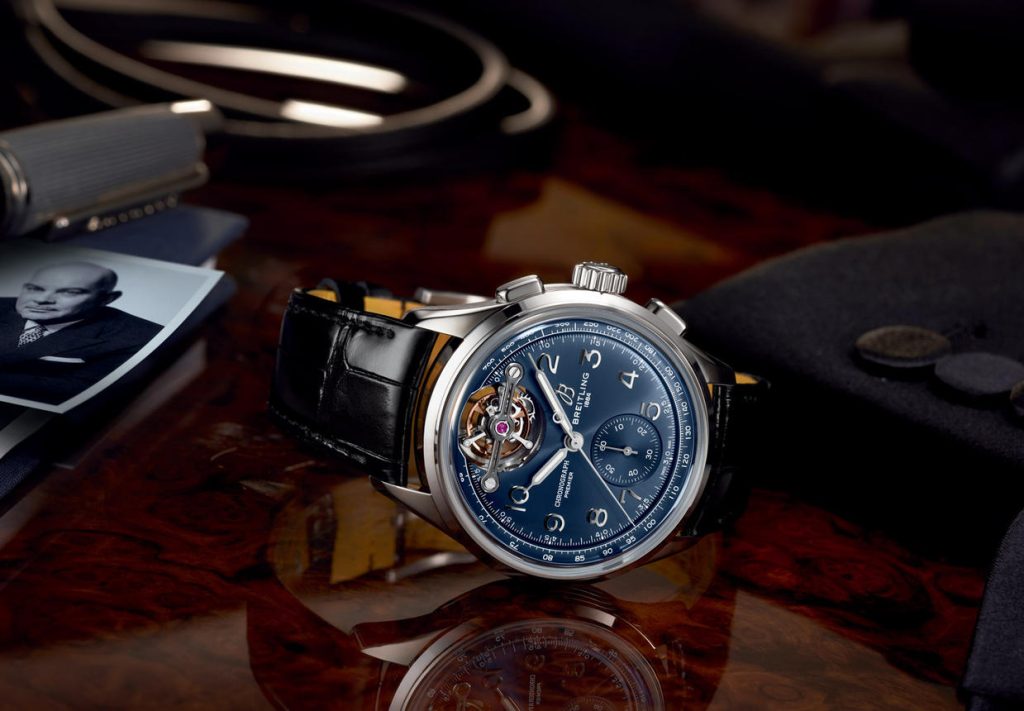
Breitling could easily have exaggerated those differences with separate dial layouts or decorative themes, but it did not. The cases, pushers, numerals and overall proportions remain consistent. That restraint is one of the reasons the watches still look coherent in 2026 rather than tied to a particular launch year.
The strongest detail is the dial architecture. The tourbillon sits at 12 o’clock, directly opposite the 60-minute chronograph counter at 6. This creates a strong vertical axis through the centre of the watch. More importantly, Breitling leaves enough negative space around both displays for the Arabic numerals to remain legible. The Breitling Premier B21 tourbillon dial layout looks complicated, but it never becomes visually noisy.
That balance is difficult to achieve. Enlarge the tourbillon opening by only a small amount and the upper half begins to dominate. Move the lower register too close to the centre and the dial loses its symmetry. Reduce the spacing around the numerals and the Premier starts to look crowded. The success of the original therefore depends less on the presence of a tourbillon than on the exact relationship between all of these elements.
The case measures 42mm across and 15.25mm thick. That thickness is substantial for a watch with traditional styling, but it makes sense once the movement is considered. Breitling is fitting an automatic chronograph, a tourbillon and a display caseback into the same watch. The relatively smooth case profile also makes the depth less visually aggressive than it would be on a sharply faceted sports case.
The 42mm Breitling Premier tourbillon is therefore not a thin dress watch, and it should not be judged as one. It is better understood as a complicated chronograph with formal styling. That distinction explains why the size feels more acceptable on the wrist than the raw thickness figure might suggest.
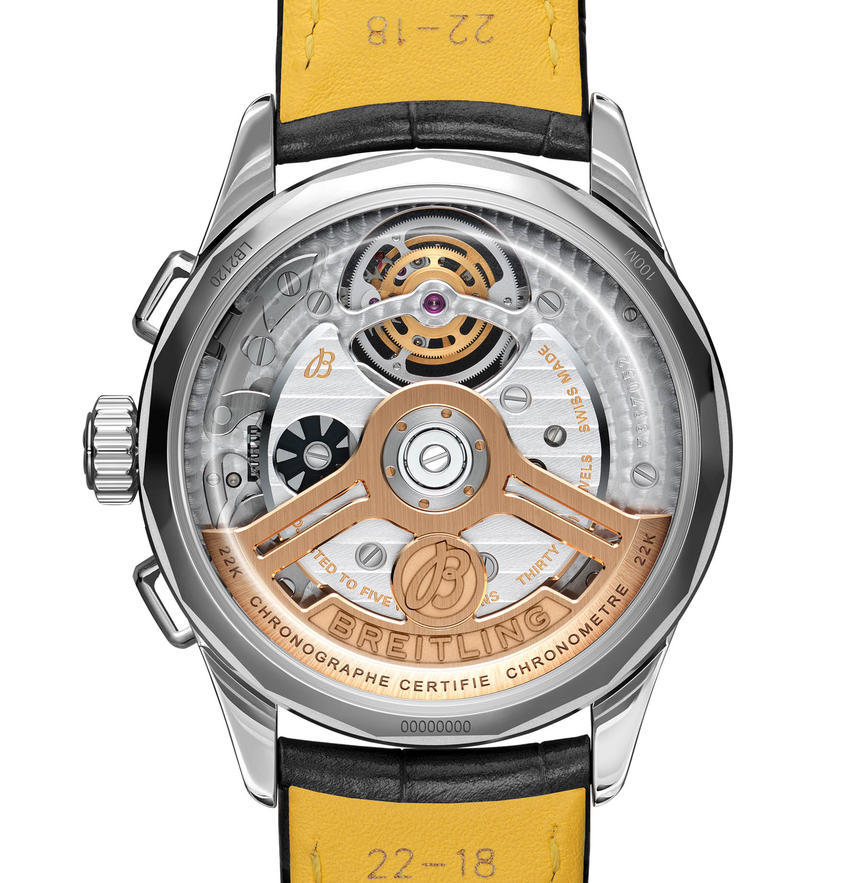
Inside is Breitling Calibre B21, developed with La Joux-Perret. The automatic movement combines a chronograph and tourbillon, runs at 28,800 vibrations per hour and offers approximately 55 hours of power reserve. Breitling currently lists 100 metres of water resistance for the watch, which gives the B21 more everyday usability than its precious-metal construction might imply.
The Breitling B21 automatic tourbillon chronograph is important because Breitling did not abandon its own identity to build it. The chronograph remains central. That matters for a brand whose modern reputation was built largely around timing watches. The tourbillon adds complexity, but the watch still feels connected to Breitling’s mechanical history rather than becoming a generic high-complication piece.
The caseback reinforces that approach. Breitling leaves the dial relatively controlled and gives the movement more visual importance from the rear. Through the sapphire back, the mechanical architecture becomes much clearer. That is a better solution than opening every part of the dial simply to advertise complexity.
Why Premier B21 Replica Watches Are Difficult to Get Right
Readers looking through our Breitling Premier watches will notice that Premier models are often harder to judge accurately from a single photograph than more heavily styled Breitlings. They appear simple, but that simplicity makes proportion more important.
On a Breitling Premier B21 replica chronograph, I would first ignore the logo and look at the vertical relationship between the tourbillon and lower register. Those two elements establish the visual balance of the entire dial. If either one is even slightly misplaced, the watch immediately looks less controlled than the original.
The next area is numeral spacing. On the genuine B21, the Arabic numerals sit comfortably around the two main displays without appearing compressed. A replica with a larger tourbillon aperture, oversized register or thicker chapter ring can force the numerals outward and make the dial look crowded even if each individual element seems reasonably accurate.
The case profile is equally revealing. A straight-on photograph can hide a great deal. Viewed from the side, the relationship between the 15.25mm case, domed crystal, rectangular pushers and crown becomes much easier to judge. A case that is too thick can make the Premier look heavy. A case that is unusually thin usually suggests very different movement construction underneath.
The pushers also matter more than they first appear. The original uses rectangular chronograph pushers that suit the formal case. If they are too rounded, too large or positioned too far from the case flank, the watch begins to lose the restrained character that separates the Premier from Breitling’s sportier chronographs.
The tourbillon itself needs the most caution. A visible rotating cage at 12 o’clock does not mean a replica is mechanically comparable to Calibre B21. The position may look similar while the underlying movement architecture, chronograph operation and power reserve are completely different. Visual resemblance and mechanical similarity should therefore be treated as separate questions.
The same applies to the precious-metal cases. Red gold, white gold and platinum differ from plated steel not only in colour but in weight, surface tone and the way polished areas reflect light. A photograph can make two materials appear close, while the difference becomes obvious once the watch is handled.
For anyone assessing Breitling Premier replica watch details, the useful checklist is therefore fairly specific: tourbillon position, chronograph register spacing, Arabic numeral placement, case thickness, pusher geometry, crystal profile, crown size, movement layout and case material. These areas say far more about the quality of a reproduction than labels such as perfect, AAA or 1:1.
The B21 trio is also a useful reference because all three versions share the same underlying architecture. That makes it easier to see how much of the watch’s personality comes from material and colour rather than a different movement or case. Léon feels warmer, Gaston more discreet and Willy more contemporary, but the proportions remain consistent across the three.
That consistency is ultimately why these watches still deserve attention in 2026. Breitling did not redesign the Premier simply because it wanted to build a more complicated and expensive watch. It kept the collection’s core proportions, introduced the B21 movement and let the complication work within an existing design language.
For a Breitling Premier replica, that sets a difficult standard. Copying the idea is relatively easy. Reproducing the balance, thickness, spacing and mechanical character that make the original convincing is much harder. That is where the real comparison should begin.